Why?
It’s no secret: most students hate math. And people carry these attutides with them well into adulthood; any math educator will tell you that the most common responses to “I’m a math teacher” fall along the lines of “I hated math in school” and “I’m so bad at math.”
 Why is it always like this?
Perhaps you, the reader, feel the same way! Or perhaps you personally liked math class, but you saw how much your friends hated it and thought that liking math was “uncool.” Being a longtime math lover myself, I’m saddened by the present state of math education and mathematical anxiety (“math phobia”) in the U.S., but my experience in the classroom and collaboration with other educators gives me hope for change.
 “Math phobia” is real and growing. What’s the root cause? That’s a question for another day…
In this blog post, I’ll be touching on one small aspect of my teaching practice that I find surprisingly effective for improving students’ engagement, depth of thought, and perception of themselves as successful math learners!
My favorite question
Originally unconsciously but now quite intentionally, I’ve found that I lean on one simple question any time I work with with a student. Regardless of whether we’re reviewing old content or learning something new, regardless of whether the student is at the top of their class or struggling to keep up in school, the question is the same:
“Why?”
Classic, I know. But more important than the question itself is when I ask the question: I don’t just ask “why” when the student gives a correct answer, but also when they say something incorrect!
Why? An example may help illustrate. I had the following exchange with a student during a recent lesson:
Me: Great! So we’ve factored the left side to get (x-6)(x+1) = 0. What next?
Student: Then x = -6 and x = 1.
Me: Why?
Student: Because those are the numbers next to the x in the factors.
Me: Sure, but why does that work?
Student: Because when you plug them into the equation, you get 0.
Me: Why? Show me.
Student: So I can plug in x = -6 and I get… wait…
Me: Hmm… what happened?
Student: I got -12 times -5, which isn’t 0… Oh wait, do I need to plug in x = 6 instead, to make the (x-6) equal to 0?
Nine times out of ten, students will “because” their way into the right answer with nothing more than a gentle nudge in the right direction! Compare this to the following:
Teacher: So we factored the left side to get (x-6)(x+1) = 0. How do we solve for $x$?
Student: Then x = -6 and x = 1.
Teacher: Well, that’s not quite right. Why is it negative 6 and positive 1?
Student: That’s the rule I remember learning in class. The answers are the numbers next to the x in the factors.
Teacher: Ah, but you forgot something important! You need to flip the sign.
Student: Oh, okay. So x = 6 and x = -1.
Teacher: Great!
Need I say more? When students are thrown baskets of rules without any expectation to comprehend the underlying logic, the “successful” students are just the quick memorizers and the “struggling” students feel ashamed that they “just don’t get math.” (Keep in mind, though, that oftentimes even the “successful” students don’t really get what’s going on at a conceptual level!) On the other hand, by leading with “why” and giving students the opportunity to form their own connected stream of reasoning, rules begin to matter less than the ability to utilize one’s intuition and logic.
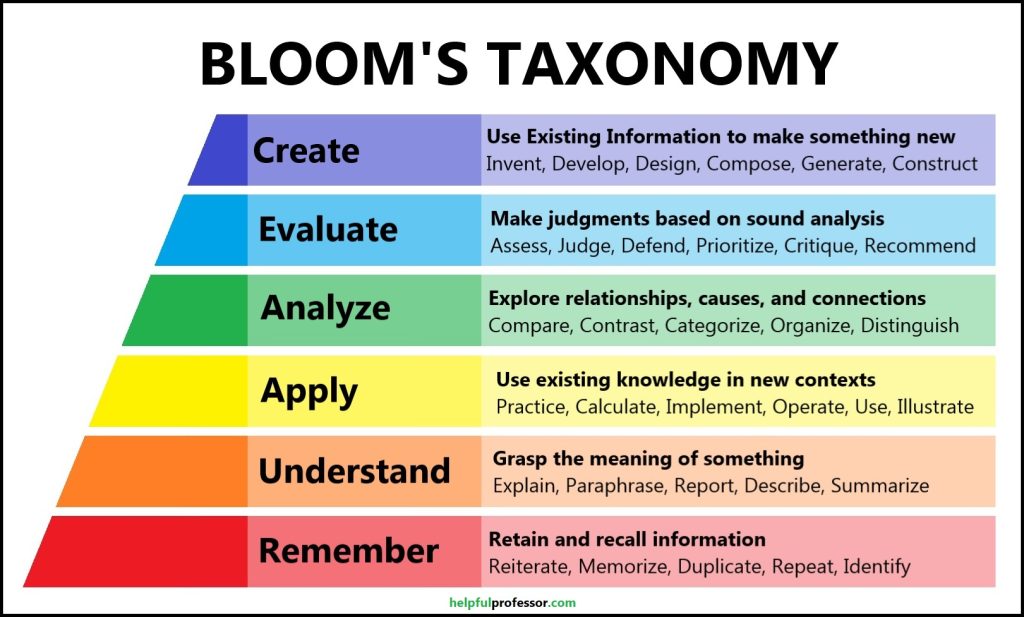 Focusing only on facts and rules keeps students at the bottom of the pyramid, but asking “why” has the potential to traverse every category!
Of course, in the real world people don’t always have someone standing around and constantly asking them to explain “why, why, why?” But as with any other skill, learning to habitually and logically justify one’s own thinking starts with people showing you how it’s done and encouraging you to do it all the time. And in my opinion, teaching students to ask “why” is a hell of a lot more valuable than conditioning them to ask “is this right?”
So, what can you do?
If you are a student: ask WHY!
- Ask your math teacher: “Why does this formula work?”
- Ask your science teacher: “Why do scientists believe that this theory is true?”
- Ask your history teacher: “Why is it important for us to know about this historical event?” (Note that this is fundamentally different from the bored “ugh, why do we have to learn this?” simply due to your positive intent and curiosity!)
- Ask your English teacher: “Why is this novel/play/author considered significant?”—or if you’re feeling up to it: “Why do you like this author?”
- And more! Get creative ^.^
If you are a parent, guardian, educator, coach, or other mentor figure: demonstrate for others what asking “why” looks like in your daily life! Challenge yourself to explain why your family or community operates the way that they do, or push yourself to openly start learning a new skill while constantly asking “why” and making mistakes along the way. No one is an expert in every subject, but it’s precisely this fact that gives you the perfect opportunity to show your kids what it means to be an open-minded and lifelong learner!
I hope my thoughts on the power of “why” in teaching provide you with something to chew on. If you are looking for high-quality tutoring that leads with curiosity and promotes critical thinking, check out my tutoring services and connect with me if you are interested in learning more. Thanks for reading, and happy studying! 📖